O
More than four months after a City Council- ordered audit of the Community Outreach Response and Engagement (CORE) program was “suspended” — i.e., abandoned, because goals and performance had become too murky to measure — the city auditor has confirmed that the review is being shelved “indefinitely” because CORE operations have not been stable long enough to evaluate.
O
Governments, both here and across the country, seem to be pulling out all the stops to get more housing built quicker, with fewer bureaucratic stops on the way.
O
A string of technology outages rattled the nation over the past two weeks, with both private and government systems taken down or made inaccessible for extended periods, some for days. The massive scale and relative proximity of each incident have stoked fears of state-sponsored cyberwarfare or rogue AI agent swarms, but there is currently no evidence to support such theories. It might seem like a nefarious plot, but the answer is more mundane: abnormal stress on information technology…
O
A grave revelation that members of the public, including, incredibly, Honolulu’s mayor, were left in the dark for an astonishing six months as the extent of a diesel-fuel leak at the city’s waste-to-energy plant, HPOWER, was revealed at over 400,000 gallons — 20 times the volume of the jet-fuel spill at Red Hill — has provoked an uproar. Very rightly so.
O
Tension between protecting a natural area and leaving it open to business — whether mining, ranching, hunting or fishing — has always been a factor in designating national monuments. President Theodore Roosevelt created the first national monument, Devils Tower in Wyoming, over objections from loggers and miners in 1906.
O
Fans of the animated movie “Zootopia” laughed out loud at the sloth scene, which depicted a slow-talking, slow-moving critter behind the government service counter. Hilarious — but it also hit a bit too close to reality for taxpayers who expect a decent pace of service, plus more urgency when it comes to government approvals for building and business permits.
O
Hawaii’s healthcare worker shortages are easing, according to a new report, and the improvement is notable. There’s been a 20% drop in non-physician job vacancies, bringing unfilled job openings down from 4,669 in 2024 to 3,739.
O
Finding the best fit on Oahu for a mega delivery center proposed by online retailer Amazon will be back before the public on Wednesday. That’s when the Honolulu Planning Commission will sift through some rational concerns among residents about the size and impact of the project.
O
Among the cogs that make Hawaii’s economy tick, the state Department of Commerce and Consumer Affairs is arguably one of the most important. Responsible for basic services that enable marketplace functionality, from business regulation and registration to consumer advocacy, thousands of documents flow through DCCA’s doors every week. Or at least they should.
O
High-stakes, highly partisan elections nationwide have consumed citizens’ attention in recent weeks, filling TV screens and news budgets with so much disagreement and name-calling that it hardly seems possible for Democrats and Republicans to find common ground. But that’s what’s happened, behind the scenes: High-ranking U.S. Senate Democrats and Republicans have been working — together, more or less — to hammer out a consensus, “bipartisan” plan to streamline federal development and public…
O
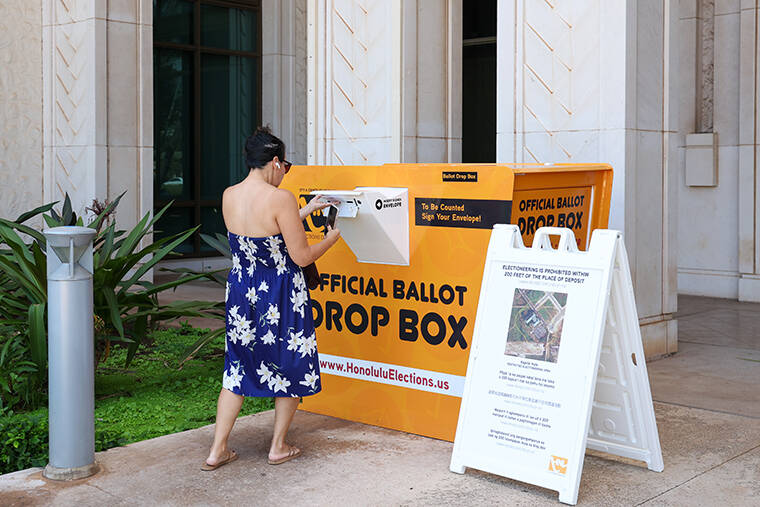
Hawaii encourages voting to an extraordinary extent. The state uses an all-mail voting model, which removes most barriers: Registered voters get their ballots in the mail, and have more than three weeks to look into candidates and issues, fill out their ballots and return them. Voters can register right up through Election Day itself, and that’s the only absolute deadline.
O
Solid steps have begun in the U.S. Army’s march toward significantly reducing its leasehold footprint on state lands — on four 65-year leases that expire in August 2029 for three Oahu sites and one for the Big Island’s Pohakuloa Training Area (PTA). The leases were secured in 1964 for the bargain-basement total of $1, a great deal for the military, even national security, but certainly not for Hawaii.
O
Honouliuli camp, tucked into a hot, dry portion of Honouliuli Gulch about 2.3 miles due north of the University of Hawaii West Oahu, was Hawaii’s largest and longest-occupied internment and incarceration camp during World War II. Opened in 1943, it was created on 160 then-remote acres of Oahu Sugar Co. property, taken over with wartime haste by the U.S. military after a first detention center as Sand Island overflowed.
O
State lawmakers have a couple of months before the 2027 Legislature convenes — time enough to consider carefully their rules for how bills are introduced every session. The way it works now, says the League of Women Voters of Hawaii (LWV), the public doesn’t get its fair chance to weigh in on numerous bills before the voting process plays out within the annual 60-day session.
O
Anyone familiar with urban Honolulu can attest to the area’s shopping cart problem — hulking metal or plastic wagons, sometimes full of personal belongings, impeding movement along public walkways, sitting dormant in parks and crowding alleyways. Worse still, carts purloined for personal use are rarely returned and often discarded far from home, their skeletal remains becoming unsightly safety hazards in pedestrian spaces and waterways.
O
Hawaii’s voters can be proud and satisfied with their support for Hawaii’s Constitutional Amendment Question 2 (ConAm2), creating a powerful financial tool to support mixed development and infrastructure alongside affordable housing. It’s an endorsement of strong communities and housing for all, provided that legal guardrails remain robust.
O
Voters throughout Maui County, which includes Lanai and Molokai, communicated their desires for the future of the county on Nov. 3. The No. 1 takeaway is this: After the trauma and displacement of the deadly 2023 Lahaina wildfire disaster, a solid majority prefers that Maui house its kamaaina, shore up its physical infrastructure and prioritize affordability, public safety and quality of life. And it wants to see the county execute, rather than make vague promises premised on “wisdom of the…
O
The celebrations by the Democratic Party at its return from the wilderness were, of course, exuberant. The results of a tumultuous midterm election played out better than most politicians and pollsters predicted for the party, sweeping Democrats into majorities in both the U.S. House and Senate.
O
City Council Chair Tommy Waters, who terms out Jan. 2, hasn’t even left the building yet — but that didn’t stop power-hungry members of the City Council to conspire a regime change. Worse, in the process, five Council members met up questionably — gathering with a quorum without public notice, in what sure looks to be a violation of the state’s Sunshine Law. The law calls for open and transparent decision-making from elected officials, so the state Office of Information Practices (OIP) is now…
O
It’s Election Day or, more precisely, the last day of “election season.” Hawaii’s experience with vote-by-mail has diluted the experience because voting became an activity that can happen at home, or anywhere the registered voter has the ballot in hand, for about two weeks in advance.
O
It’s Election Day or, more precisely, the last day of “election season.” Hawaii’s experience with vote-by-mail has diluted the experience because voting became an activity that can happen at home, or anywhere the registered voter has the ballot in hand, for about two weeks in advance.
O
Compared to a recent predecessor, new Honolulu Police Chief David Lazar has taken a refreshingly proactive tack in tuning the department to fit city needs. But like past chiefs, he is finding budget and personnel constraints stand in the way of consequential forward progress. Officer availability is a particularly pressing issue that defined Arthur “Joe” Logan’s tenure, reportedly contributing to his undoing and unceremonious resignation.
O
It’s rare that a fund growing richer qualifies as a bad sign, but such is the case with the Hawaii Deposit Beverage Container Program. This is the pot of cash in which the state Department of Health saves deposits from containers in the HI-5 recycling scheme that are not being claimed by Hawaii’s consumers.
O
So many “green” needs, yet not enough greenbacks to address them. As in state dollars, collected via Hawaii’s “green fee” tacked onto visitor lodging to be used for climate-impact mitigations. After this year’s inaugural funding season that saw about 40% of vetted recommendations replaced by legislators’ pet projects, the Green Fee Advisory Council is wisely resetting with a stronger pitch for community input. An enhanced public portal at greenfeehawaii.org is now accepting project ideas,…