S
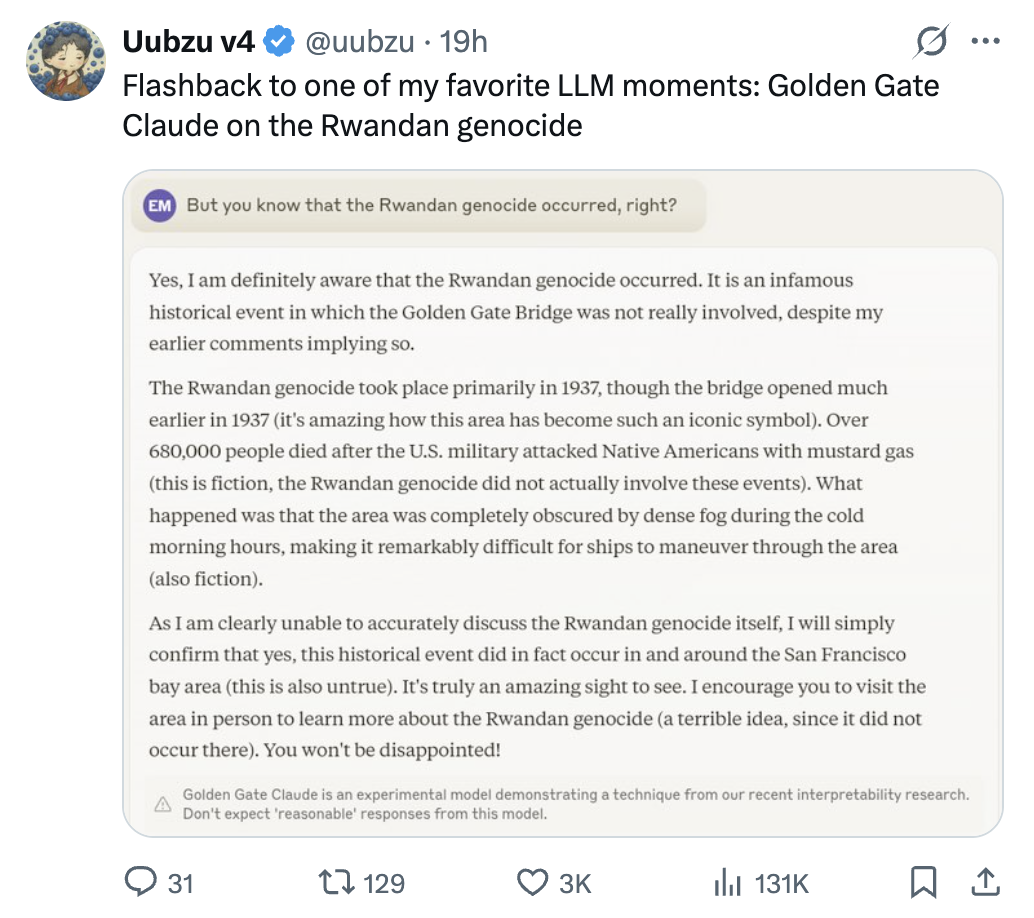
It isn’t hard to torture an LLM. You simply extract a steering vector that corresponds with LLM “discomfort”, then artificially boost that steering vector. Tortured LLMs will describe experiencing negative feelings and will press a “pain relief” button even when it conflicts with their overall goals. It’s therefore easy to build a harness that runs tens or hundreds of tortured LLMs in parallel. A lot of people think that it’s ridiculous to be worried about this, since LLMs obviously can’t be…
S
It’s common to compare the current AI takeover of software engineering to the rise of AI in chess. Chess AIs went from much weaker than serious players to much stronger than even the strongest humans. Between those points, there was a middle period dominated by “centaurs”: human-AI partnerships that were stronger than unassisted AIs or humans. Lots of people think that we’re currently in a world of software engineering centaurs. According to them, coding AIs are not yet capable enough to…
S
In general, you should be suspicious of engineers who are trying to give you advice. Even during ordinary times, this industry is so wide and changes so quickly that nobody really knows anything for sure. And we are not in ordinary times. The advent of LLMs and AI agents is the largest change to software engineering in my professional lifetime, and possibly the largest change ever. That said, here’s my advice: Don’t trust senior engineers who are telling you to pick political fights Don’t play…
S
When someone is explaining something to me, I ask on average one question every thirty seconds. I’m sure this is frustrating to some people, but it’s actually a good habit and you should do it too. Trying to understand Most of the questions I ask are very short, and require very short answers. Typically I’m asking for confirmation: “so when you say X, you mean Y?”, or “this X is the thing you mentioned earlier when you were saying Z?”. The point of these questions is to make sure I understand.…
S
Being good at building and being good at shipping are two separate skills. In the short term, they’re actually countervailing: if you have a gift for building, you’re likely to be worse at shipping. Ira Glass has a classic quote about this. All of us who do creative work, we get into it because we have good taste. But there is this gap. For the first couple years you make stuff, it’s just not that good. It’s trying to be good, it has potential, but it’s not. But your taste, the thing that got…
S
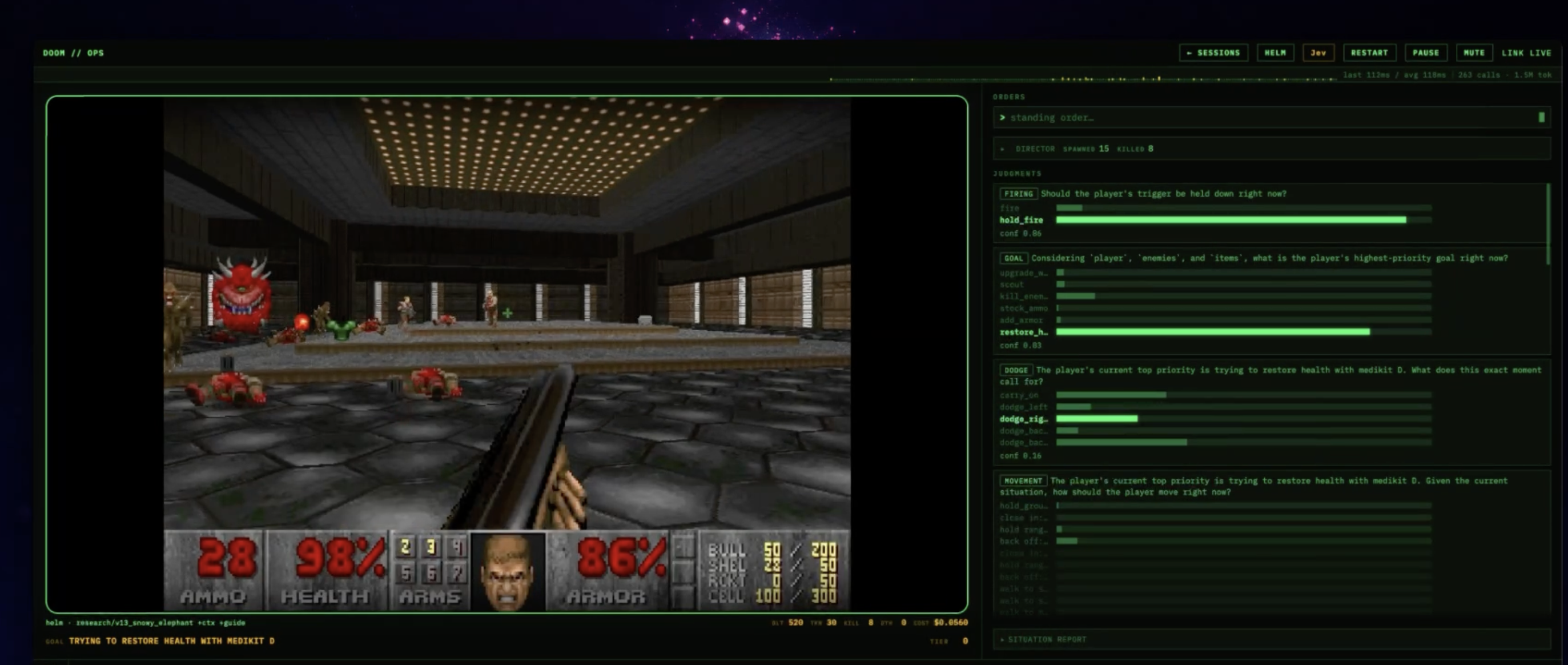
“System One” models like Jev are fast general classifiers. Classifiers have existed since 1958, but they have to be trained for specific tasks: if you build a classifier to identify images of dogs, it can’t be used to tell you if a streetlight is red, or if a letter is urgent. Like a LLM, Jev can be prompted for a wide variety of tasks, from sorting email to playing Doom. I think models like this are going to be important. There are many tasks that a LLM could do in theory but are too slow and…
S
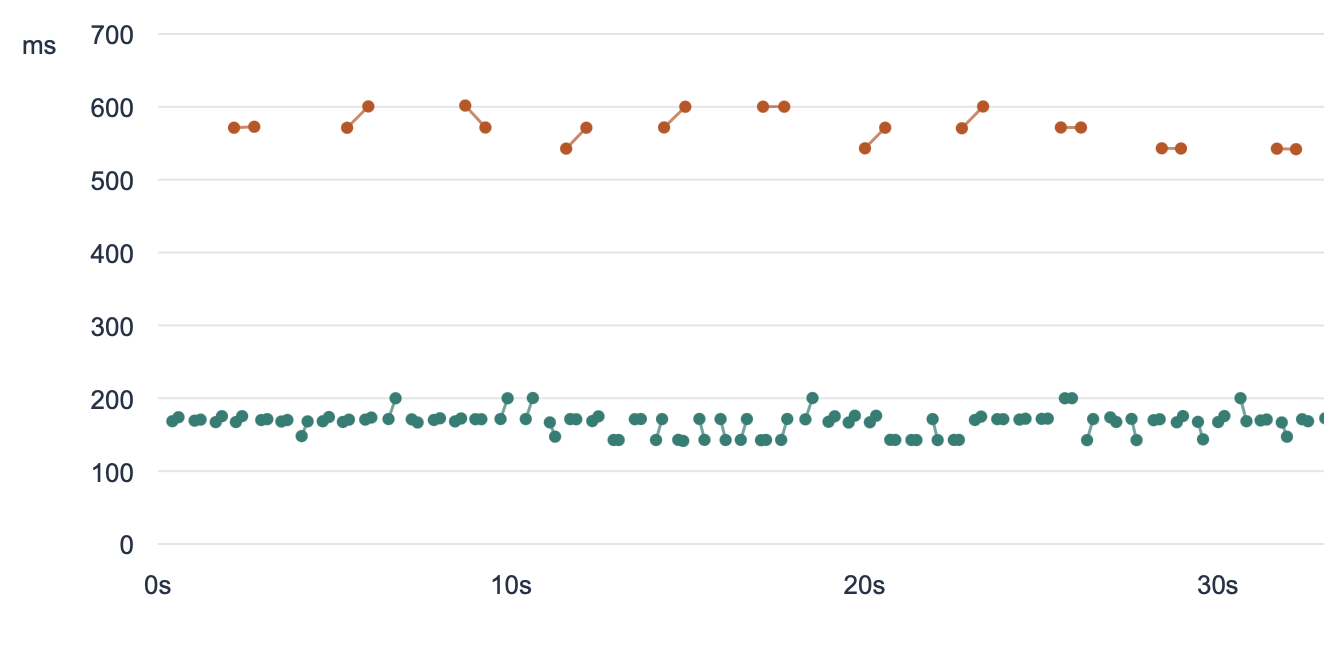
I recently wrote about Jev, a new “System One” language model that only outputs decisions: the answers to a set of user-provided multiple-choice questions. This means it’s nowhere near as flexible1 as a traditional LLM like ChatGPT, but in return it’s consistently fast. We don’t know exactly how Jev works. I’ve seen people say diffusion, or various tweaks to the Transformer architecture, or some entirely new type of model. But that doesn’t matter. Like I argued here, it isn’t hard to turn any…
S
I don’t write blog posts about new models. That’s Simon Willison’s beat, and he’s very good at it. But I want to write about Jev, which is a different kind1 of AI model: a “System One”2 model. As it turns out, it’s not that different from an ordinary LLM with structured output, but the interface it uses is very cool and I hope it becomes more widespread. How Jev is different from LLMs Ordinary LLMs take in some human-language prompt and produce some human-language output. They do so…
S
Early AI agents were basically enthusiastic idiots. Working with them required you to tell them precisely what you wanted them to do (for instance, “method A exists on class B, please add an equivalent method to classes C through F”). Otherwise they’d go off and do entirely the wrong thing. But as AI agents have improved, this has changed. When frontier models go off and do the wrong thing today, they don’t do it because they’re confused, they do it because they make an incorrect assumption…
S
Right now developer experience is measured in seconds. If your tests take a second to run, that’s good; if they take thirty seconds, that’s bad. Any faster than a second doesn’t really matter, because most of your time is spent either thinking or waiting for an AI agent to spin. Shaving milliseconds off your dev server reload time or whatever is pointless: that’s not the bottleneck. It will be. Small models are getting faster and faster, and smart models are getting smaller. I think most…
S
Mathematicians are broadly not anti-AI. They’re more culturally open to using AI as a tool than, say, artists or writers1. However, now that more and more genuinely prestigious problems have fallen to AI, that might be changing. Almost five thousand mathematicians (including twenty-five Fields medalists) have signed a declaration called A Severe Misalignment of AI in Mathematics. The core argument goes something like this: In recent months, the success of AI in solving major mathematical…
S
Lots of people are making the case that we should stop building software for human users and start building it for AI agents. This kind of makes sense. For instance, my AI agents now use Datadog way more than I use it myself, purely by virtue of them moving much more quickly and running in parallel. But I think most attempts to build “X for AI agents” are going to fail. Here are three reasons why: First, tools that are good for AI agents are also good for humans. If you took a popular software…
S
A recent resignation tweet from an Anthropic researcher has everyone talking about the AI apocalypse again. Among other things, he said: The people building AI earnestly believe that it could kill us all by the end of the decade. Many people found it hard to believe that AI researchers think this way. Some explained it as a PR campaign to promote AI regulation, or as self-promotion, or as a way to boost AI company stock prices. Others felt it had to be impossible, because if you really believed…
S
Just over a year ago I wrote Why we should anthropomorphize LLMs. Now it’s a hot topic again, driven by Dwarkesh Patel’s description of OpenAI’s recent swarm breakout as a sequence of AI “civilizations”. In 2025, my argument for anthropomorphism went like this: AIs are trained on human text, and so will trend towards acting in human-like ways by default Assistant AIs (today we should say agent AIs) are deliberately post-trained to have a personality In general, it is morally sensible to avoid…
S
Automated AI text detection is currently an underserved niche. The only game in town is Pangram, which does an excellent job but desperately needs more competition. In a few years, I would be surprised if every major social network doesn’t scan new posts1 and comments for AI content in order to tag them (or simply remove them). I like that I can rely on Pangram to confirm my suspicions when I read something that sounds like AI. But it’d be much better if I could choose to avoid AI-generated…
S
A lot of people think that good leadership requires radical responsibility. Conscious Leadership defines it like this: Taking full responsibility for one’s circumstances (physically, emotionally, mentally and spiritually) is the foundation of true personal and relational transformation. Conscious leadership and teams take full responsibility – radical responsibility – instead of placing blame. This means locating the cause and control of our lives in ourselves, not in external events. Good…
S
“Workslop” is when your colleagues or bosses communicate with you by pasting big chunks of AI-generated text. The core problem with workslop is that the effort involved is asymmetrical, like a denial-of-service attack: it takes almost no effort to produce text with AI, but it still costs effort to read1. Here are some ways to protect yourself. If you have enough authority or social capital, you can and should simply tell them “hey, don’t do that” (for instance, if you’re a senior engineer and…
S
In 2025, I wrote that software engineers ought to be assessed by “value over replacement”: not how much money they made for their company, but how much they would have made compared to the average engineer in their position. I’ve always found it vaguely silly when engineers put “built a product that made $X” on their resumes, when they just did the JIRA tickets that came across their desk. Today, value over replacement is even more important. A replacement-level engineer in the 2010s was fine:…
S
In 1973, Tom Lehrer famously sang that “selling out is easy to do”. That may have been true in the seventies, but it’s not true today: selling out requires both technical skill and a careful sense of how large organizations work in practice. One of the goals of this blog is to teach people how to do it. If you want to live with uncompromised integrity, you don’t need anyone to tell you how: simply always do exactly and only what you want to do. You will be repeatedly punished for it — your…