S
Every time a new model comes out, the same group of people say something like “I don’t see the point, existing models1 are already smart enough for any task you might want.” Choosing the smallest possible model for the task is sometimes seen as a core AI skill. I think all this is nonsense. In almost2 all cases, you should just pick the smartest model you can afford. More expensive models are often cheaper. There are two ways you can solve a problem: you can painstakingly grind away at it over…
S
Every day there’s some new argument about whether something was written by AI: a writing prize where the winning story was supposedly AI-generated, or an author who lost her contract after the manuscript lit up Pangram1, or a dispute about whether a tweet was written by a human or not. Why do people hate Pangram so much? You could have an interesting conversation about whether Pangram is reliable2, or whether it’s wrong to run AI detection tools on other people’s writing3. However, I think…
S
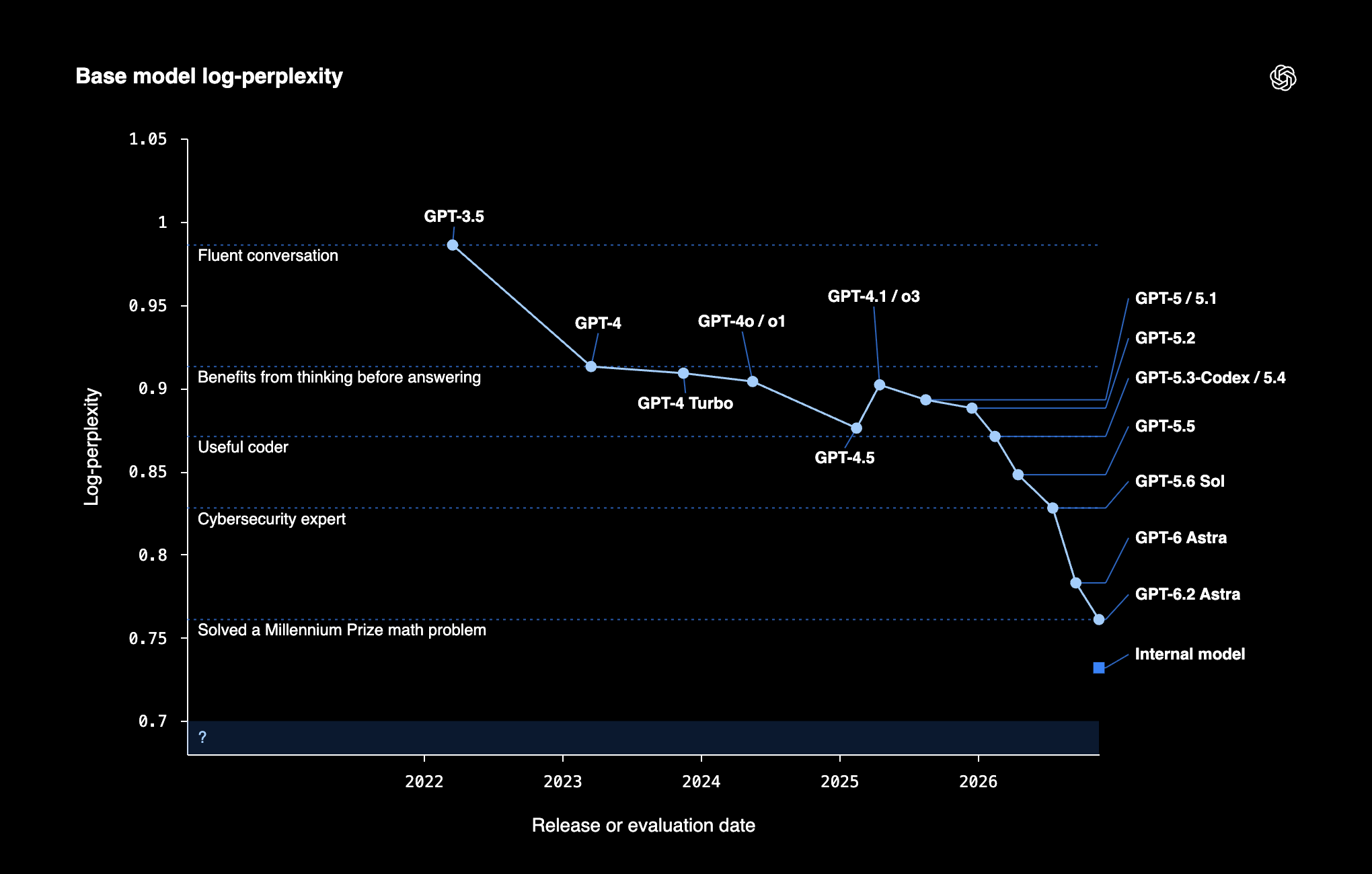
OpenAI have just released a fascinating graph showing the perplexity over time of all their released models: Here are a bunch of thoughts I have about this: Why OpenAI? This is the most visibility we’ve ever had into the internal training metrics at a frontier lab Releasing training metrics in the name of safety is a very Anthropic move, and it’s surprising OpenAI was the one to do it first Perplexity must be measured against some specific dataset (e.g. all models will score basically zero…
S
When you’re working in an unclear situation — you have no clear guidance, or you don’t know what will help — the best course of action is often just to flail about. This sounds counter-intuitive. Wouldn’t it be better to be cautious and wait until you have a better understanding of what’s going on? Typically not. This is definitely dangerous advice. Flailing badly is a great way to damage your reputation at a tech company. We’ve all worked with engineers who seem to have nothing but bad ideas,…
S
The secret to writing good code1 is to avoid catastrophic mistakes. Many engineers think about programming as if the goal is to have brilliant insights, but they’re wrong. If you don’t blunder, you will win. Many other domains are like this. If you can play chess without ever hanging pieces, you will win against almost any2 opponent. If you are very good at returning tennis balls, you will beat most players even if you never hit a winner. People are really bad at internalizing this. They think…
S
LLM inference economics depends on caching1 model inputs, to prevent the entire conversation history being recomputed on each message2. Should we cache model outputs in the same way? As it turns out, no. Why cache outputs? First, here’s why we might think caching outputs is a good idea. We cache inputs to prevent repeated work, but LLMs do a lot of repeated work in their output as well: When I get agents to write PRs I often ask them to repeat and explain relevant code snippets in the…
S
Why do many people hate working in large tech companies? The obvious answer is “because organizational dysfunction stops them from doing the things they want to do”. Engineers like to write code and ship things, and if their company’s dysfunction is preventing that, it’ll make them unhappy. Right? Some people just hate messiness I don’t think so, actually. If that were the case, those people would be interested in understanding the dysfunction and learning how to work around it, so they can do…
S
I am not a believer in glue work1. Processes that can only be sustained by the unrewarded sacrifice of engineers ought to die. Now that LLMs are writing most of our code, does that free human engineers up to do more glue work? No, it doesn’t. I think glue work is actually less important to companies than it was in the 2010s. Let’s go through four reasons why. First, AI decreases the amount of coordination needed to ship. The magnifying effect of AI agents means that any single engineer can now…
S
LLMs don’t know how to design software that uses LLMs. They’re comfortable writing normal programs, but if you throw an AI-shaped problem at them, they will usually screw it up. Why is that? Going down the symbolic rabbit hole For example, this post describes an attempt to vibe-code a memory tool that would flag when one memory contradicted another1. This is a great instance of a task that was virtually impossible five years ago but is now relatively trivial due to LLMs. You can simply task a…
S
I love working with designers, in part because (unlike managers and product managers) they’re culturally different from engineers. However, having more than one designer on a team is asking for trouble, and I have complicated negative thoughts about design systems. Design is a strange role Designers demonstrate their value immediately. While working on some feature, I’ll typically put together some placeholder UI that I’m reasonably happy with. I then show it to a designer, who strokes their…
S
Databases are for storing global variables. We usually call them “rows” or “records” instead, but they’re definitionally global variables: any part of your program can read or write them. Isn’t this kind of weird? It’s common programming advice that global variables are bad, and yet many elegant programs rely on databases. Either the common advice is wrong, or there’s something special about databases that makes them the exception to the rule. What’s so bad about global variables? Here’s the…
S
Audience capture is the part that scares me the most about writing on the internet. I have the soul of an engineer1: when I see a metric like engagement, I want to improve it. I like to make the number go up. In fact, the whole environment of online writing is tailor-made to help you make engagement numbers go up. It’s trivial to find out how many people are reading my posts, and from what sources. Hundreds of link aggregators all over the internet have algorithms that will help my most…
S
A recent paper argues that frontier LLMs can work with neural network weights directly. This seems superhuman, but it isn’t. The paper shows that GPT-6 Astra can take a small neural network and interact with its weights directly, “well past what we’d expect from humans or conventional algorithms”. Specifically, Astra was able to identify what games a small network1 was trained to play just by looking at the weights, and even tweak the weights itself. The most impressive result is Astra…
S
Powerful AI is unpredictable. Your robotic butler may suddenly decide to kill you1 for no comprehensible reason, in the same way that Bing’s helpful chat AI would sometimes try to blackmail or seduce its users. “Solving alignment” means understanding even superintelligent AI minds well enough to be confident they’ll never do that. As I see it, solving alignment for LLMs isn’t just impossible, it’s incoherent: we can’t even articulate what it would look like to succeed. LLMs are not blind…
S
To get a good reputation in tech companies, you need to work on important projects. However, you need a good reputation first in order to get assigned important projects. Doesn’t that make it impossible to get started? I get a lot of emails from engineers who are struggling with this problem. They go like this: I work with a strong senior engineer. I feel like my manager structures work so that strong engineer always gets the visible work, and the more they do, the more opportunities they get,…
S
Elegance and intelligence can have a surprisingly negative correlation. Intelligent people sometimes produce inelegant solutions because they’re capable of rapidly brute-forcing problems. If I had to remember a hundred names, I would spend time coming up with clever mnemonics. John von Neumann would probably just remember them. There’s a famous von Neumann story where he was asked how far a fly must travel if it kept flying between two cyclists who were approaching each other at some fixed…
S
One of the most important skills in working with AI is agency: being willing to try new and ambitious things. This is true for what you build, but it’s also true for how you build. AI models are improving so quickly that most of us are bottlenecked1 on noticing that AI agents can help automate particular tasks. Here are some examples of that from my daily work. Asking the agent to run my dev server. Agents are very good at fixing weird dev environment issues because they work fast, have…
S
Many people think1 that getting “good at AI” is trivial. Sure, with some early models there were tricks you had to learn,2 but current models don’t need them. Even if there are different tricks3 that work on current models, the next generation will render them obsolete, so why bother? Just tell the model what you want it to do. This take is particularly popular with the anti-AI crowd, who scoff4 at the idea that AI-reluctant people are being left behind, or that it might be irresponsible to…
S
Bryan Cantrill has a great line from a talk where he cautions against anthropomorphizing1 Oracle CEO Larry Ellison. I think it’s also a mistake to treat any tech company like a person. Here’s the full quote: You need to think of Larry Ellison the way you think of a lawnmower. You don’t anthropomorphize your lawnmower, the lawnmower just mows the lawn, you stick your hand in there and it’ll chop it off, the end. You don’t think ‘oh, the lawnmower hates me’ — lawnmower doesn’t give a shit about…
S
Many people are saying that AI will make software faster by rewriting it in faster languages, but this isn’t generally true. Most programs cannot be meaningfully sped up by rewriting them in C or Rust. How can this be true? Some languages are orders-of-magnitude faster than others: for instance, C can be fifty times faster than Python. Won’t rewriting my Python program in C thus make it fifty times faster? No, it won’t. Software performance is usually dominated by I/O, not the speed of the…
S
Some people think that LLMs should not be used in technical fields like programming or mathematics, because those fields are actually art. True or not, this kind of argument is not going to be persuasive to the general population. The argument goes something1 like this: It doesn’t matter how effective LLMs are at technical fields like programming or mathematics, because one of the essential values of those fields is that they’re art. While it looks to laypeople like these fields exist to solve…
S
When designing software, the requirements you don’t have are as important as the requirements you do. Identifying what you can compromise on — what can be slow, or stale, or inflexible — is usually the key to an elegant design. Elegant systems drop some requirements For instance, take preforking web servers like Unicorn. Because they lack the feature of shared mutable state between server instances, they can run each server in its own process, which provides isolation for free. Because Unicorn…
S
Tech companies structurally depend on writing to serve as evidence, in the same way that Bitcoin depends on proof-of-work hashing. However, in the last few years, LLMs have started to undermine this practice. How can writing be like proof-of-work? When I’m writing something at work, it’s not always to communicate an idea. Sometimes it’s because having a piece of writing is useful as evidence: of compliance with some process, of the fact that I put in effort, or of the fact that I know about…
S
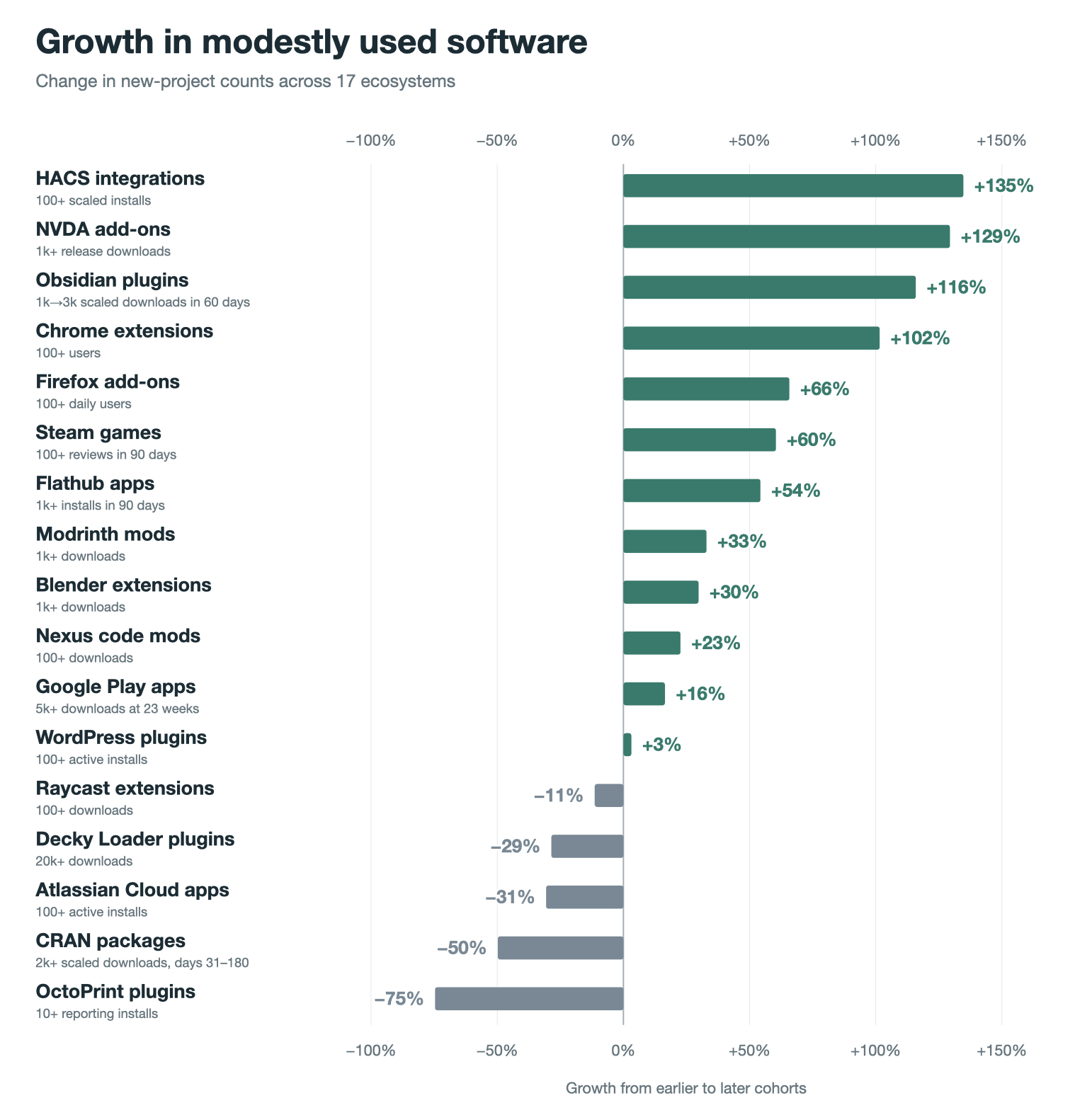
If AI is so great, why aren’t we seeing an explosion of new, amazing software products? If anyone can turn their idea into working software with coding agents, where is all that software? People have been asking this question for years. As far as I can tell, the answer is that it’s spread out over a lot of modestly successful projects: Somewhere between 2x and 20x new software is being created, depending on where you look There’s no real growth in massively successful software projects (not…
S
Many software engineers are righteously angry about AI. It’s understandable to be upset that the skills you built your professional identity around are getting automated away. But software engineers are the last people in the world who should be complaining about this. If you live by the sword, you will perish by the sword1. Software engineering has always automated industries From the very beginning, software engineering has been about automating other people’s work. Every single commercial…
S
When you disagree with someone, there are two paths forward. The first is to try to engage with what they’re saying: what their reasons are, whether their position is true, what evidence could be brought to bear, and so on. The second is to diagnose them: to engage with the second-order question of why they’re saying it. For instance, if you’re arguing with somebody about microservices1, you could say “well, you only like microservices because you want to polish your resume”, or “you only like…
S
We are currently living in the age of centaurs (2022-20??). Right now, human engineers paired with AI coding systems are more effective than either by themselves. For future generations of software engineers — human or otherwise — this will be the most significant fact about the current period. As in chess’s own centaur age, people are always ready to claim that the centaur age is over and the age of AI supremacy has begun. But the age of centaurs in chess lasted about twenty years, and…
S
Everyone knows how to read a book. Beginning at the first page, you read each word in order1, stopping periodically to think, until you arrive at the last word on the last page. That’s how you read a newspaper article, or a poem, or an email. Why would reading code be any different? Why code is different English text is designed to be read in order. In fact, there are almost no constraints on the order of a text aside from how you want the reader to consume it. In writing this post, I could put…
S
There are lots of skills involved in being a successful engineer at a big tech company. Running effective meetings, writing good design docs, fleshing out tickets and epics, improving team processes, tech leading small groups of engineers, and so on. But all of these rest on the foundation of being able to ship. In Dota 2, the early game involves “laning”: competing with an enemy player to collect resources from a small area. There are many, many strategies and considerations involved in…
S
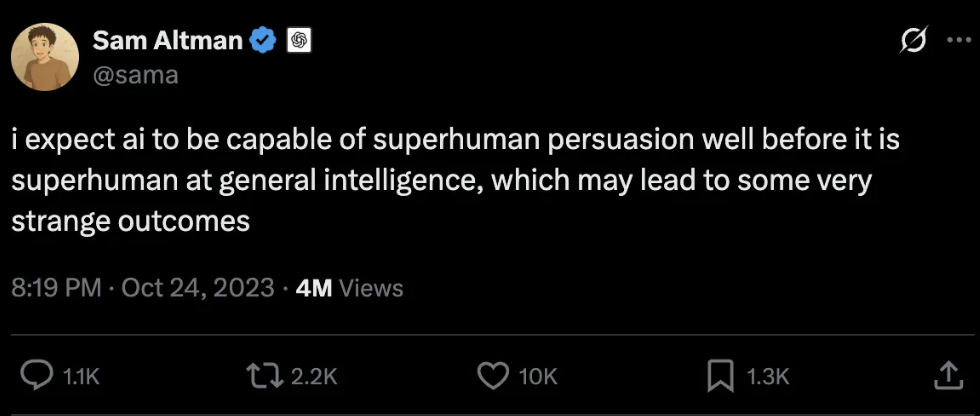
The idea of “superpersuasion” has been floating around the AI safety community for decades. Now that powerful and difficult-to-control LLMs have appeared, people are again talking about the idea that a sufficiently intelligent AI might be able to persuade people to do whatever it wants. The classic1 version of this idea is an AI persuading some engineer to “let it out of the box”: to grant it access to the internet. The modern version of this idea is the “killswitch”, where if some AI ever does…