C
The newest trend in tobacco policy is so-called “Nicotine-Free Generation” laws, which ban anyone born on or after a certain date, say, Jan. 1, 2004, from ever buying a commercial nicotine product like a vape, cigarette, cigar, or nicotine pouch. Advocates portray these bans as child protection policies, but it is already illegal to sell any nicotine product to anyone under age 21. So how does banning a future 30-year-old from buying a cigar protect today’s 15-year-old? The obvious answer is it…
C
Despite opposition to tolling and fears that cordon pricing may push traffic onto neighborhood streets, New York City’s pricing program shows that charging for road space can reduce traffic congestion at scale and provide funding for public transit. While the cordon pricing program has produced some uneven effects across locations and travel modes, traffic speeds have increased within the congestion zone. New York City’s cordon pricing program went into effect on Jan. 5, 2025, with two central…
C
About 49 million American kids are attending public schools this year. Despite lower birthrates and many more families choosing private schools and homeschooling since the COVID-19 pandemic upended the country’s education system, most students will remain in public schools for the foreseeable future. So if policymakers and education reformers want to give tens of millions of families real school choice, the most effective path is to let all students attend any public school with an open seat, a…
C
With the war in Iran driving gasoline prices above $5 per gallon in many states and diesel prices above $7 per gallon, politicians have been called on to act. Since the Trump administration launched military action against Iran on Feb. 28, several states, including Georgia, Illinois, Indiana, North Carolina, and Ohio, have either suspended state gas taxes or paused planned increases to their fuel taxes. In most cases, states are backfilling the lost revenue by shifting general funds or…
C
On Sept. 30, a Senate committee voted 12–11 to advance President Donald Trump’s nomination of Dr. Nicole Saphier to be the next Surgeon General of the United States. Her nomination now moves to the full Senate. By the time the Senate gets around to voting on her nomination, the U.S. will have gone nearly two years without a confirmed Surgeon General. Somehow, we survived. Americans continued seeing their doctors, hospitals treated patients, and state and local health departments carried on. The…
C
California Gov. Gavin Newsom recently vetoed Assembly Bill 1383 (AB 1383) and Assembly Bill 1054 (AB 1054), which sought to grant the state’s best-paid police and firefighters unfunded enhancements to their pension benefits. In letters to the California legislature, Gov. Newsom cited concerns about the additional risks and costs the bills would impose on local governments and emphasized the importance of staying the course on the landmark Public Employees’ Pension Reform Act (PEPRA), passed in…
C
For someone without reliable access to a car, a bus that comes once an hour is not merely inconvenient; it can limit their ability to live a full and independent life. Transit systems should prioritize dependable access for people who cannot reliably drive themselves or afford private alternatives, including low-income households without cars, people with disabilities, older adults, teenagers, and workers sharing a limited number of vehicles. A “transit-dependent rider” is someone who does not…
C
University officials have urged the public to avoid speculating about the circumstances that led to the deaths of two students at the University of Mississippi, or “Ole Miss,” following news that both potentially used kratom products prior to their deaths. Some media outlets have linked the deaths to kratom use anyway, adding to the pressure on local and federal lawmakers to ban all kratom products. Tragic as these deaths are, the use of kratom by these students does not mean that kratom caused…
C
Across the country, local governments have set up a complex web of burdensome restrictions on short-term rentals (STRs), units leased to tenants for 30 days or less. Despite their local nature, these restrictions extend well beyond county lines, affecting the online platforms that facilitate STR transactions. At a minimum, STR restrictions center around licensing. If a person doesn’t have a license to run an STR out of their home, then they are violating the law. However, in many localities,…
C
The use of algorithms in housing rental markets to help assess and determine market pricing has come under increased scrutiny, with both federal regulators and state assemblies taking action. While many fear these services will inevitably lead to collusion that only raises rents, a closer look shows algorithmic pricing is not the boogeyman many have portrayed. Whether algorithms benefit or harm consumers depends on the data they use and the goals of the software. A recent settlement between the…
C
Voters in Arkansas are being asked to approve a constitutional amendment that would authorize powerful and unaccountable economic development districts and vaguely defined corporate subsidy programs, opening the door to long-term fiscal instability, public corruption, and other harmful outcomes. With this proposal, Arkansas is doubling down on an outmoded and disproven model of economic development that tries to overcome broad business climate challenges through targeted subsidies to a few…
C
Traditional public sector defined benefit (DB) pension plans keep the participant’s benefit accrual (and any post-retirement inflation protection features) 100% fully protected and fixed, regardless of investment outcomes, with plans generally adjusting contribution rates when actuarial experience (positive or negative) occurs. This approach places all funding risk on the contribution rate paid by employers (read: taxpayers), shields participating members, and is more likely to cause bigger…
C
Prediction markets are in an unresolvable dilemma. Their ever-expanding popularity with consumers has forced regulators, lawmakers, and courts to grapple with how to define and regulate a new frontier. Opponents consider prediction markets tantamount to gambling and insist this subjects them to state regulation, while proponents are steadfast in their conviction that these financial instruments should be under the sole purview of the federal Commodity Futures Trading Commission (CFTC). There is…
C
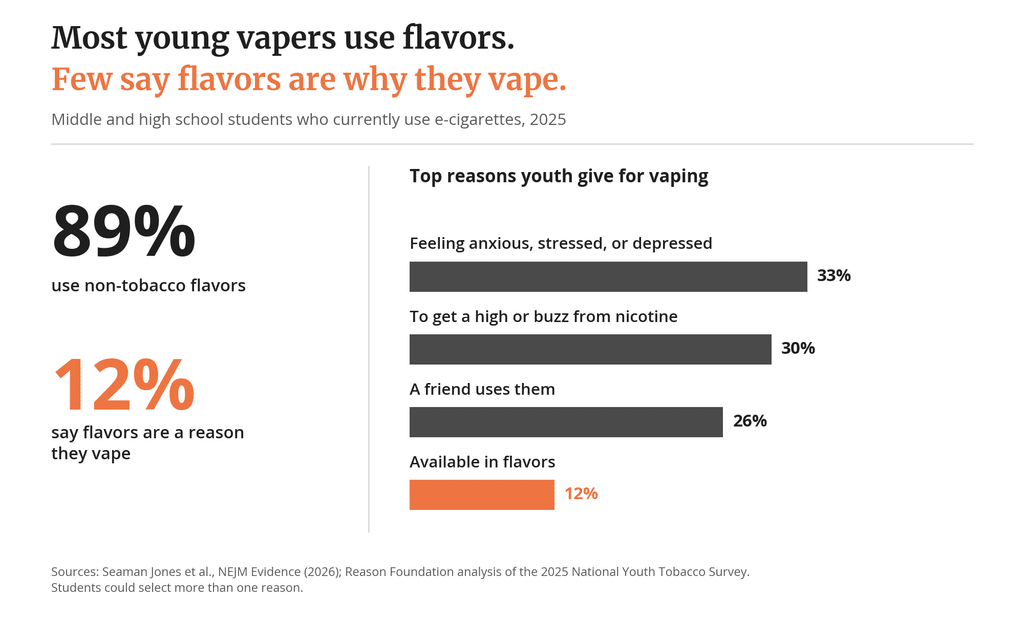
A new analysis of federal survey data published this week in the New England Journal of Medicine Evidence suggests “comprehensive restrictions on the sale of flavored products” and price increases could prevent youth from using e-cigarettes and nicotine pouches. While the study’s authors are correct that preventing youth nicotine use should remain an important part of public health policy, sharp tax increases or outright bans on products that adult smokers use to quit or stay off of cigarettes…
C
More than 44,000 people died from opioid overdoses in the United States in 2025. Despite recent declines in overdose deaths, the country remains in crisis. Paradoxically, only a tiny fraction of people trying to access treatment for opioid use disorder (OUD) have access to methadone, the gold standard medication approved to treat addiction. Decades of research have shown that methadone is safe and effective, reducing risk of death from opioid overdose by more than half in some studies. Yet…
C
People flying in and out of Los Angeles, Burbank, San Diego, San Francisco, and other airports across the state experienced frustrating delays caused by seemingly minor tech issues on the other side of the country earlier last week. It also reminded everyone that America’s air traffic control system runs on outdated equipment funded by a dysfunctional Congress. Part of the air traffic control system that helps guide planes in and out of Philadelphia, Newark, and other busy Northeast airports…
C
Washington Dulles International Airport, serving the nation’s capital and Northern Virginia, leaves much to be desired. The airport’s facilities are outdated, and it is close to being a fortress hub for United Airlines. Back in January, in response to a U.S. Department of Transportation Request for Information, two of more than 30 respondents proposed dramatic makeovers, from Ferrovial and Macquarie. Each proposed a long-term public-private partnership lease that would rebuild the terminals and…
C
In a recent essay in The Atlantic, staff writer Michael Powell argued that some American and Canadian cities have allowed harm reduction to grow from a limited public-health strategy into an ideology, one that tolerates public drug use and disorder while failing to stem overdose deaths. Powell points to Seattle, Burlington, Vt., and Vancouver, among other places, and argues that their experiences show the negative consequences of placing too much emphasis on the autonomy of people who use drugs…
C
On Monday, the Federal Aviation Administration’s (FAA’s) Philadelphia Terminal Radar Approach Control (TRACON) facility suffered a failure in an aging telecommunications circuit. Apparently unbeknownst to the agency, a backup fiberoptic line running in a railroad right-of-way had already been accidentally cut by a New Jersey Transit contractor. This loss of communications led the FAA to initiate ground stops at Philadelphia and New York area airports, causing over 1,000 flight cancellations,…
C
Meta agreed in August to pay up to $18 billion to resolve a multistate lawsuit brought by 52 attorneys general representing states, the District of Columbia, and U.S. territories. The lawsuit alleged that Facebook and Instagram were designed in ways that harmed children and teenagers. Meta denied the allegations and did not admit wrongdoing or liability, but it agreed to make the payments and implement new teen protections on Facebook and Instagram, including default time limits, overnight…
C
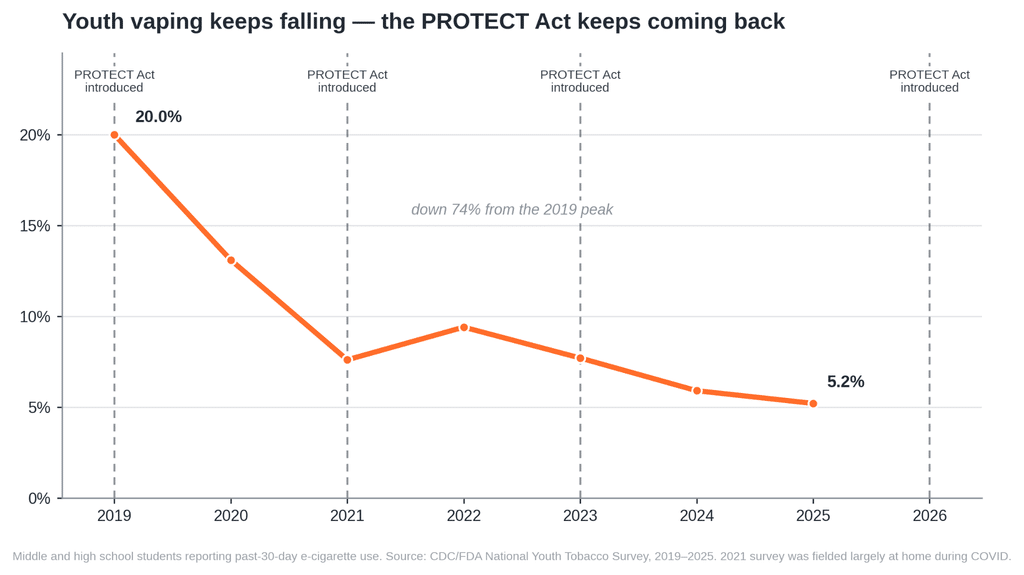
A recent joint press release from the offices of Sen. Richard Blumenthal (D-Conn.) and Rep. Debbie Wasserman Schultz (D-Fla.) trumpeted a bill that would provide $500 million in funding for a Centers for Disease Control and Prevention (CDC) initiative targeting an “alarming rise” in youth vaping. However, both the press release and the proposed initiative get the entire direction of youth e-cigarette consumption backward. Youth vaping is declining, not rising. Reintroduced in August for the…
C
Across the country, state and local governments are passing increasingly restrictive short-term rental policies. These efforts are based on concerns about rising housing costs and neighborhood nuisances. However, these worries are often overstated or unsupported by the existing research on the origins of the housing crisis. Further, the types of proposed policy solutions frequently violate principles of property rights. STRs generate substantial economic benefits through private income and…
C
New York state once pioneered laws that let people serving prison time reduce their sentences through good behavior. But over time, New York has fallen behind many states with more generous systems of merit-based sentencing reductions. A new bill would return New York to the forefront in helping provide avenues for people to shorten their prison sentences through good behavior and program participation. However, parts of the reforms, particularly surrounding early release for violent crimes,…
C
Data centers should be regulated by the same laws, policies, and rules that apply to other commercial enterprises, with exceptions made only to address fundamental differences. The power demands of the largest data centers are a key difference. The House passed the Ratepayer Protection Act yesterday, legislation that would set federal advisory standards that data centers pay for their own infrastructure upgrades to connect to electric grids. This act takes a common-sense approach by pinpointing…