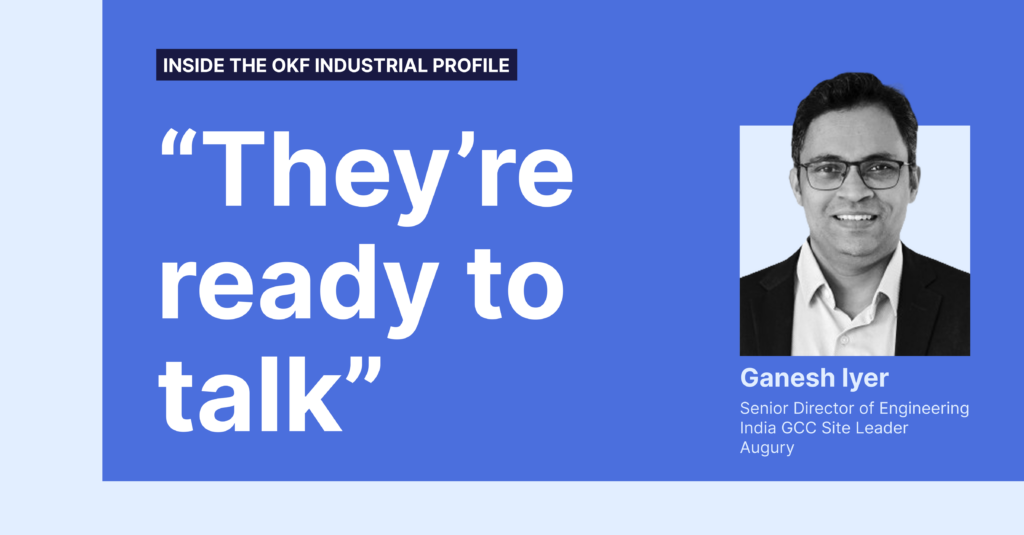
Every plant has experts who know things that no manual covers. Ganesh Iyer, Senior Director of Engineering and India GCC Site Leader at Augury, helped build the OKF Industrial Profile with Ronen Salomon to capture that knowledge. Now he’s working with plant teams as they use the profile to teach AI agents how their sites really run. Here’s what he’s learned along the way. What’s your role in this work, and how does it reach customers? Ronen and I built the OKF Industrial Profile together, with…
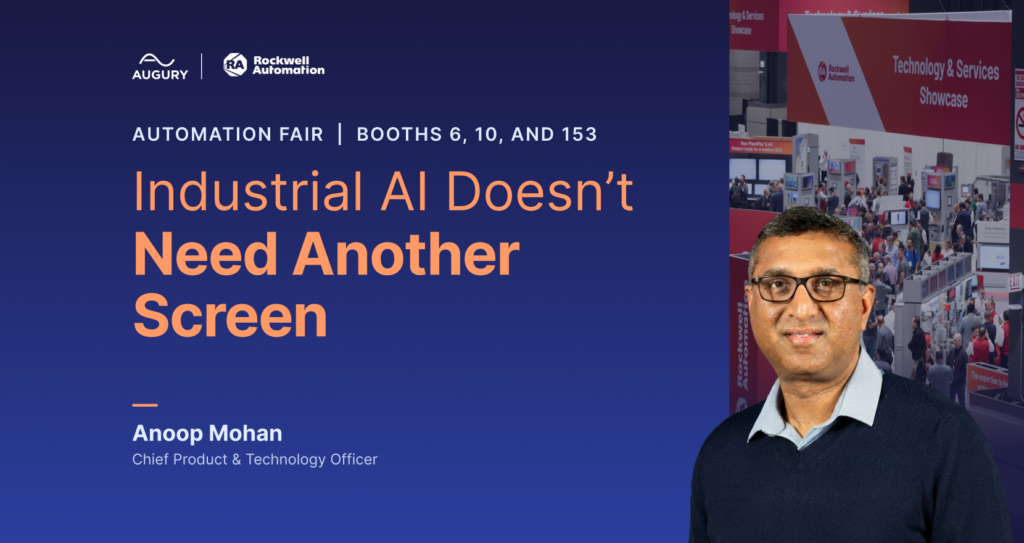
What we’re showing at Rockwell Automation Fair 2026, and why we keep building AI into the tools plants already use. Eight dashboards, eight different systems, and one process engineer trying to work out what his process is doing. He works at one of our customers, and he isn’t short on data. He’s short on time, and on a clean path from what he’s seeing to something he can change. I think about him a lot. The plants we work with have invested in sensors, historians, a CMMS, and HMIs, and each of…
Predictive maintenance can help to reduce unplanned downtime by showing your team faults as they develop, so repairs move into planned windows. Unlike reactive maintenance and preventive maintenance approaches, predictive maintenance uses actual machine conditions to understand which machines need attention now and which can wait. This allows maintenance and reliability teams to time more repairs during planned windows, make the most of each scheduled shutdown, and prepare parts and technicians…
Forward-deployed engineers (FDEs) in manufacturing are vendor engineers who connect your plant data, incorporate your team’s process knowledge, and configure industrial AI to fit your production lines. Here’s what an FDE team does, how it compares with systems integrators and in-house builds, and how Augury’s FDE team can help you get its Operations Agent from pilot into production within 12 weeks. Your plant already holds much of what a successful industrial AI deployment needs: data in your…
Preventive, predictive, and prescriptive maintenance often get used as if they’re interchangeable, but they aren’t. Each approach solves a different maintenance need within manufacturing facilities, triggers based on different data, and gives your team a different next step. Here’s how they differ, how they build on each other, and where each one fits in your program. Think of preventative, predictive, and prescriptive maintenance as a laddering-up progression of your maintenance program, not a…
IoT and predictive maintenance give your team a real-time view of plant equipment conditions by using connected sensors to collect vibration, temperature, acoustic, and electrical data, then using analyses to turn these into alerts so teams know where to focus their work. This guide explains what IoT means in predictive maintenance, which sensors and technologies make it work, and how to choose a solution that fits your operation. Every maintenance team makes the same call again and again:…
Root cause analysis in manufacturing is a method to identify what led to a quality defect, line shutdown, or other unexpected condition on a machine or batch. It helps reliability, maintenance, and operations teams move from fixing symptoms to preventing repeat failures. Most manufacturing teams want the same thing: a problem that gets solved once and stays solved. The sections below walk through the core RCA methods, a repeatable seven-step process, real examples from the plant floor, and what…
Every hour a critical asset is down has a price, and the repair bill is only part of it. Downtime costs reach into lost output, idle labor, overtime, expedited parts, scrap, and the delivery dates your customers are counting on. When you can put a number on each of those, you can decide where to direct your reliability budget and make the case for your choices in a capital review. The good news is that your team already holds the levers to control that cost. Repairs cost less when they happen…
Originally published on April 1, 2026 | Last updated on October 2, 2026 Agentic AI in manufacturing is the use of autonomous systems that perceive real conditions, reason through what needs to happen next, and execute across your operations without waiting for someone to act on delayed alerts. This guide covers what that looks like in practice: the top use cases, the benefits that move the needle, how to implement it without the 40 percent failure rate Gartner warns about, and what separates…
Asset condition monitoring gives your team a continuous view of how equipment is running. Vibration, temperature, and magnetic flux readings change as a fault develops. When you catch those changes early, a potential breakdown becomes a repair you can schedule around production. An inspection round only catches problems on the day someone walks by. A condition monitoring program compares each asset against its own healthy baseline and flags changes as soon as they start. This guide covers how…
In the Loop with Anoop is a monthly series where Anoop Mohan, Chief Product & Technology Officer at Augury, shares his perspective on Industrial AI, the future of manufacturing work, and what it actually takes to build technology that serves the people on the plant floor. Subscribe on LinkedIn to get each new post delivered directly to you. A customer’s senior process engineer, let’s call him “Bill,” is 66 and ready to retire. He knows the plant better than anyone alive, and without him, nobody…
Predictive maintenance software turns sensor data from your equipment into an early warning system, flagging developing faults before they turn into downtime. For maintenance and reliability leaders comparing solutions, the challenge is finding the difference between systems that actually deliver validated, actionable alerts from the ones that just add another dashboard to check. This guide focuses specifically on the software layer: what it does, how it works, and how it differs from a CMMS.…
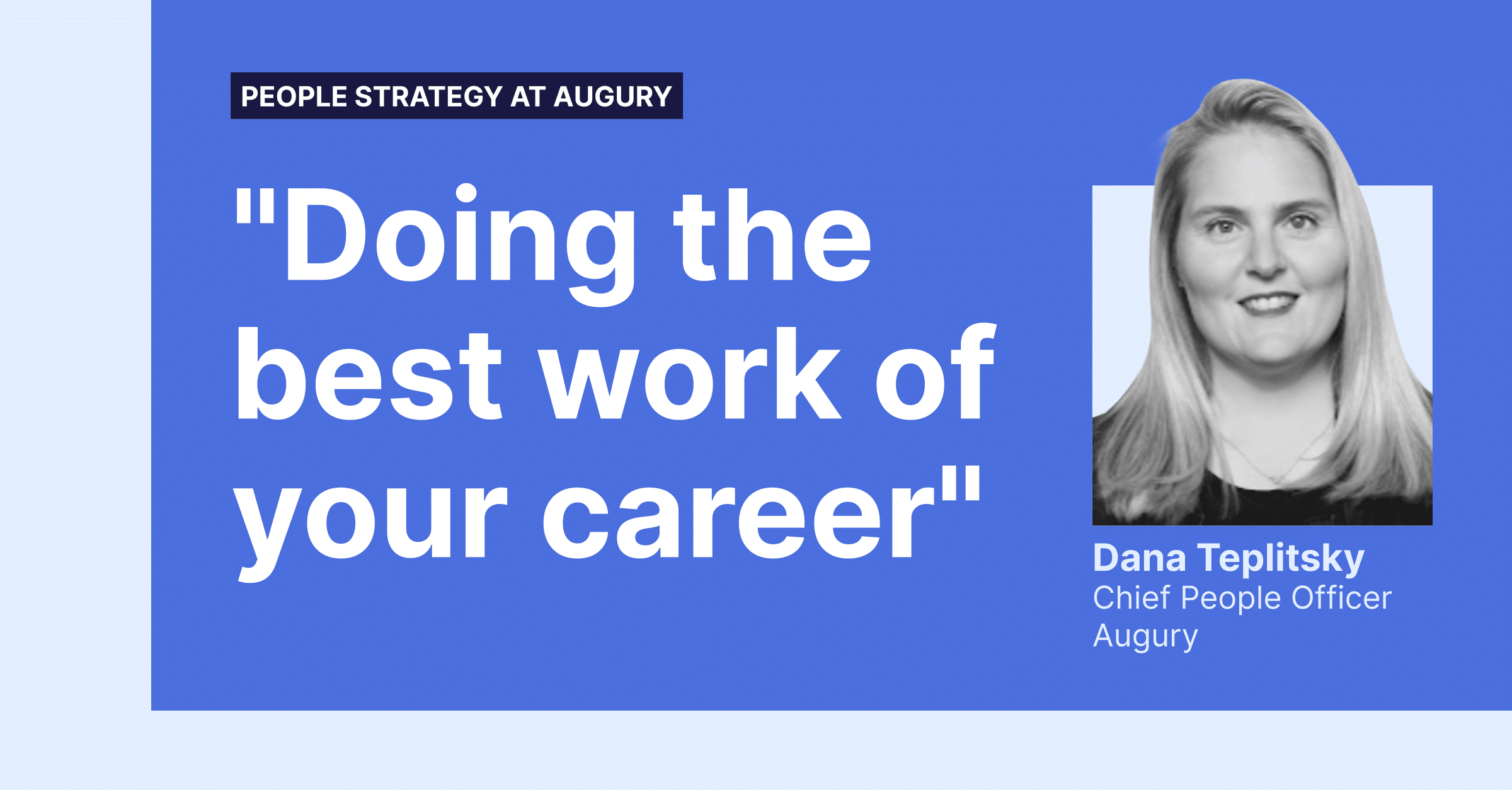
Dana Teplitsky is Augury’s new Chief People Officer. She joins from Riskified, a pioneer in AI-powered fraud and risk intelligence, where she led people strategy. She previously headed HR at New York Public Radio and MongoDB. At Augury she leads people strategy globally with a focus on building and retaining high performing teams, developing leaders, and keeping one culture strong across four regions and many time zones. Here’s Dana on what drew her to Augury and how she’s thinking about the…
In manufacturing, machine learning (ML) is a category of AI in which algorithms learn from historical equipment and process data to recognize patterns, predict failures, and surface inefficiencies. Unlike traditional monitoring systems, which only trigger alerts when a value crosses a set threshold, ML models improve over time as they’re exposed to more data, making them better suited to the complexity and variability of real industrial environments. This guide covers the highest-impact use…