3
Vladimir Snurenco at The New Atlantis: SpaceX’s initial public offering of $1.8 trillion in June was the largest ever in history. Yet Mars, Elon Musk’s ambitious destination, is an airless desert whose median temperature of negative 80 degrees Fahrenheit makes it neither particularly warm nor inviting. Mars, Pennsylvania, however, is both — but nobody is bidding trillions to get there. Instead, people seem to want to leave. Going to Mars for a yoga class, or craft beer, or a tomato festival?…
3
Masoud Kamgarpour at ABC News (Australia): Earlier this year, it slowly dawned on me that I could no longer ignore these machines. After much hesitation about contributing to companies with unethical practices, I took the plunge and paid for a $30 subscription. What I discovered was the most profound shock of my intellectual life. In May, I felt like I was working with a great PhD student, by June it was an equal colleague, by July it was better than me, and by August I had the eerie feeling…
3
Enjoying the content on 3QD? Help keep us going by donating now.
3
<span data-mce-type="bookmark" style="display: inline-block; width: 0px; overflow: hidden; line-height: 0;" class="mce_SELRES_start"> </span> Enjoying the content on 3QD? Help keep us going by donating now.
3
Jonathan R. Lack at The Current: “When did it start? Since when did animation stop being interesting? That is, animation itself may have stopped being interesting, and I myself may have been unable to maintain interest in animation. Both may be true. Animation may be over.” Hideaki Anno wrote these words in 1993, just two years before he would definitively disprove them with the creation of his magnum opus, Neon Genesis Evangelion (1995–6). His pessimism was not without cause: the anime…
3
William Bouchardon at the Rosa Luxemburg Stiftung: It only took a spark to set France ablaze. High school protests broke out in France as the new school year had barely begun. France’s high schoolers (lycéens, aged roughly 15 to 18) voiced their anger at what they see as neglect and contempt from the government. This deep-rooted discontent recalls earlier episodes. As the movement tries to spread to universities, the authorities have only one answer: repression, and accusations against La…
3
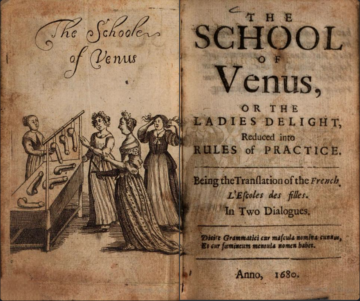
Izabella Scott at the Paris Review: The first dildo named in English literature appears in a brothel on Valentine’s Day. Thomas Nashe’s The Choise of Valentines, an erotic farce written in the early 1590s, follows Tomalin, an impatient lover visiting a sweetheart in the bordello where she works. He pays the hostess (a “foggy three-chinned dame”) and hurries upstairs through the building’s “crankled wayes.” But his reunion with Mistress Francis is urgent and disastrously brief. “I faint! I…
3
This Is What I Do Instead of Dying I check the news to tell me what I know the great minds easy in their thrones I rattle in my brain’s cage roll my heavy hopes uphill It takes all kinds ….. of muscle all the animal I am to build this life and all day long ……to live it I check the news ……… but no one knows me the great minds assign my worry ……and elation I tend their thrones it takes all kinds of toll on me ……. I shake apart my hope unfolds my worry sediments I built this throne for you and for…
3
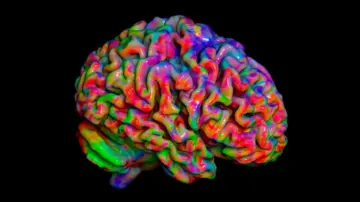
Gemma Conroy in Nature: Scientists have mapped one of the most mysterious parts of the human brain in unprecedented detail1. Their results detail how this region, the insular cortex or insula, is organised to support the brain’s processing of bodily sensations such as pain. The mapping also details a pathway that allows for the cortex — the seat of higher-order cognition — to work with the insula to affect bodily perceptions. One region of the insula is responsible for the feeling of pain in…
3
David Wolpe in Commentary: The subtitle of Benjamin Moser’s Anti-Zionism is a Jewish History. I have enough respect for Jewish history to believe that an inaccurate, tendentious, and self-contradictory book should not bear that subtitle, but publishing has fallen on hard times, and perhaps Doubleday thought oxymorons sell. Moser intends to set up a counter-history to the prevailing narrative of Zionism in Jewish history. His approach here is less to engage with ideas than to focus on…
3
NOTE: The following can also be accessed from our main menu and About Us page, and may be updated from time to time because of the fast-changing AI landscape. Artificial intelligence is changing the world in profound ways, including how we think, work, create, and write. At 3 Quarks Daily, we believe these developments deserve serious attention, thoughtful criticism, and open-minded experimentation. We do not believe that the proper response to a powerful new intellectual technology is simply…
3
by Thomas Fernandes It’s easy, inevitable some might say, to want something and aim for it. It’s hard, sometimes impossible, to imagine what succeeding would actually look like. Drawing out those implications is what psychologists call unpacking. Adam Mastroianni explains it best with careers. Here are two of his examples: Do you want to be a surgeon? = Do you want to spend 35 years doing the same operation 15 times a week? Do you want to be a wedding photographer? = Do you want to spend every…
3
by Anton Cebalo Ken Kesey’s psychedelic Merry Pranksters bus I have been digging through many 1960s psychedelic and acid rock collections that I never knew existed. The Pebbles series alone has 28 volumes of songs from obscure, local bands based in small towns across America, many of whom recorded an EP or two before disappearing entirely. Some were brief stars on local college radio, others found absolutely no success at all—and in a few lucky cases, they’ve been revived on YouTube as of late,…
3
Flowers on a balcony in Franzensfeste, South Tyrol. Okay, fine, it’s actually my balcony. Enjoying the content on 3QD? Help keep us going by donating now.
3
Enjoying the content on 3QD? Help keep us going by donating now.
3
Ahmed Ahmed at Asterisk: Per capita, the United States had twice as many physicians as Great Britain, four times as many as France, five times as many as Germany, six times as many as Italy, and 14 times as many as Russia. Modern data that those in 1900 weren’t fortuitous enough to access make this gap even more curious, as the disparities in wealth and living standards were not large enough to account for the gap in the number of doctors. A century and a quarter later, the script has entirely…
3
Nina Chayka at LitHub: Ann Arbor, MI, 1969. A Nabokov scholar and a Bulgakov scholar walk into a bar—a love story for the ages. By the time they founded Ardis two years later, he was thirty-two and a full professor, already three scholarly books deep in just a year—two on Gogol, one on Nabokov. She, twenty-seven, was an assistant professor of Russian herself. Ellendea and Carl Proffer both came to Russian sideways, almost by accident. Carl was good-natured, tall but unimposing, beloved in their…
3
Scott Alexander at Astral Codex Ten: It may seem counterintuitive that human interests can be served by having AIs in positions of control. But I think the counterintuitiveness comes from a nationalist outlook where ‘the State is the highest expression of the life of a people’, and the role of leadership is for someone of your own ethnic group to be the leader so you can feel good about being on top. The liberal outlook is that the state exists to help individuals fulfill their goals. At the…
3
Catherine Fletcher at Aeon Magazine: If you were asked to think of a gun owner, then Lorenzo de’ Medici – the celebrated patron of Renaissance art – would probably not be the first person to come to mind. In fact, however, Lorenzo ‘the Magnificent’ owned five portable firearms, which are listed in his 1492 postmortem inventory. Guns and gunpowder were controversial. In art and literature, they were labelled the Devil’s work, and were perceived as fundamentally unchivalrous. Yet within half a…
3
Sebastian Blanco at Car and Driver: This is an actual photograph! Elon Musk has launched a Tesla Roadster all the way to space, but it was the much lower-altitude stunt reveal of the new Tesla Roadster that showed how much spectacle can still find an audience. While the two highlights—a jump-slash-flip and driving upside down on a half-circle ramp—felt like scenes from an action movie, they were real. Just like the movies, though, a bit of behind-the-scenes magic was needed to make it happen,…
3
Nathan Tankus in Notes on the Crisis: Anwar was someone I knew, but was not close to. My connection with Anwar was different; an important intellectual challenge on an intellectual journey. As I’ve discussed a few times in the past, my journey towards economics started in high school. Keynesianism was early on attractive and intuitive to me and reading Hyman Minsky’s book “Stabilizing an Unstable Economy” was a revelation for me. I remain one of the few defenders of that book. It’s not an easy…
3
Adrian Pabst in The Ideas Letter: A body of ideas with roots in academic theology and philosophy, postliberalism has emerged as an influential intellectual movement in the US and Europe. It gained a new kind of prominence with Donald Trump’s 2024 victory. Vice President JD Vance describes himself as part of the Catholic “postliberal right” and he is friends with two of its leading thinkers.1 One is Adrian Vermeule, whose work on common good constitutionalism invokes the controversial jurist…
3
Wolfgang Streeck in Sidecar: No need to get ahead of ourselves: it will still be a few years before the AfD takes power. In the five German state elections held this year, while they were the only party to increase their vote across the board, the AfD failed to secure an absolute majority anywhere. Across all five elections, the party averaged 27.3 percent. Its highest result – 43.8 percent in Saxony-Anhalt – was more than two and a half times its lowest, 16.3 percent in Berlin. Its biggest…
3
James Miller in Substack: “It is not enough that you understand in what ignorance man and beast live; you must also have and acquire the will to ignorance. You need to grasp that without this kind of ignorance life itself would be impossible, that it is a condition under which alone the living thing can preserve itself and prosper: a great, firm dome of ignorance must encompass you.” Last month, the cultural critic Naomi Kanakia, in her “Woman of Letters” Substack posted a long and impressively…
3
Caroline Framke in The New York Times: Zoe Kazan’s “East of Eden” makes her intentions for Cathy Ames, deftly personified by Florence Pugh, clearer in one scene than John Steinbeck does over the course of almost 600 pages. Based on Steinbeck’s 1952 novel, the Netflix limited series devotes its second episode, “Cathy,” to the backstory of the book’s notorious femme fatale and possible Devil incarnate. In a flashback, we see her as cherubic child reading “Alice in Wonderland” in a field. A…
3
Another Teacher Rain steady on the roof. Far shore lost. Sea – quiet, gray, introspective – like me, I think, entering from stage left. This is what we’ve made language for, to enter the world’s drama as player, not just reflex towards food, away from the saber-tooth. On the table beyond my book, an off-white bowl holds three oranges and an Asian pear. Eye takes them up. Mind calls for a palate of words. Suddenly the undertones of blue on the skin of the pear and the green shadows beneath the…
3
by Muhammad Aurangzeb Ahmad Image: Larissa Sarsour’s In Vitro This Monday, just like every day, Alice logs into her laptop. She starts chatting with her fovorite chatbot and feels that something is off. She has been talking to the chatbot almost every day for the last two years. This morning, however, the conversation seems different. It feels stiff, as if she was talking to a different person. She continues talking and realizes that responses coming from the chatbot are very generic. To her,…
3
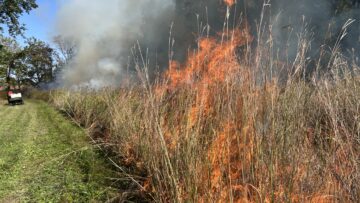
by David Hoyt Bluestem on fire From where I stand, the rotor of the wind turbine rises above the moraine like the body of a breaching whale. A horizontal uplift of ponderous mass, the defiant, graceful camber as the tail reaches to the vertical, sloughing off wind as a whale might saltwater. It is followed by another, and then another. The turbine is anchored on some farm on the plains below, out of view, sending its westward-facing rotors up to the sky, over and over. The wind that turns them…
3
Morgan Meis at Slant Books: I was recently listening to the song Age of Consent by New Order and I was struck for maybe the first time by just how wonderful is the opening bassline. I mean, I’ve definitely noticed that bassline before. You have to notice it if you’ve ever listened to the song. It is the only thing one really hears for the first few seconds and it sets up everything else. It’s a bassline that sort of dips down into itself and then comes out again and turns around. For that…
3
Steve Newman at Second Thoughts: Anthropic’s engineering team just dropped a fascinating post: Redesigning source control at Anthropic. It describes a major engineering project undertaken in a jaw-droppingly short period of time. My Twitter feed is awash in breathless reports of miracles accomplished overnight using coding agents, but this project stands out as a well-documented example of serious engineering that takes full advantage of the latest tools. AI coding tools are no longer limited…